

Last Updated: October 25, 2026
Quick Summary
To choose lures Ohio River fishing demands, start by reading the water, clarity, current speed, and season dictate which lures trigger strikes. Match lure type, size, and color to water conditions: natural colors in clear water, high-contrast lures in muddy water, and heavier presentations in fast current near dams.
- Use suspending jerkbaits and lipless crankbaits in early spring when water is in the 50s.
- Switch to tube baits and Ned rigs in mid-spring as water reaches the low 60s and bass move shallow to spawn.
- Use spinnerbaits with Colorado blades in muddy water and willow leaf blades in clear water.
- Size up lures slightly in muddy water to create more vibration and visibility.
- Build a core selection of tubes, jerkbaits, football-head jigs, spinnerbaits, and crankbaits to cover 80% of Ohio River situations.
Table of Contents
- Understanding Ohio River Conditions and Lure Selection
- Best Lures for River Bass in Spring and Early Summer
- River Fishing Lures for Current: Rigs and Retrieves
- Lures for Muddy Water Fishing: Color and Visibility
- Spinnerbaits and Inline Spinners for Multispecies Fishing
- Building Your Ohio River Lure Selection
- Frequently Asked Questions
Understanding Ohio River Conditions and Lure Selection
When you choose lures Ohio River fishing demands, start by reading the water. Clarity, current speed, and season dictate which lures trigger strikes.
At 573 Lures, we've analyzed what works across Ohio River scenarios, from clear to muddy, fast near dams to slow slack-water pools, each favoring different lures. For a comprehensive guide on specific lures for different Ohio River conditions, see our best lures for Ohio River fishing guide.
Water Clarity and Color Choices
Water clarity is the first decision point.
In clear water, natural colors work best. Silvers, blacks, and browns mimic real baitfish, and fish that see your lure clearly are picky.
Muddy water is different. According to Ohio Department of Natural Resources fishing guidance, dark-colored baits work in spring when water runs high and murky, while lighter colors perform better in fall when water clears.
For muddy conditions, use high-contrast colors: chartreuse stands out, white creates visibility, and black provides silhouette. Learn a proven system for selecting lure colors with our color blueprint.
Current, Flow, and Lure Timing
Current speed changes how lures behave.
In fast water, speed up, the current already moves your lure. In slow water, slow down and let the lure do the work.
Current also affects where fish position: breaks from the flow, behind rocks, deeper slots, and drop-offs.
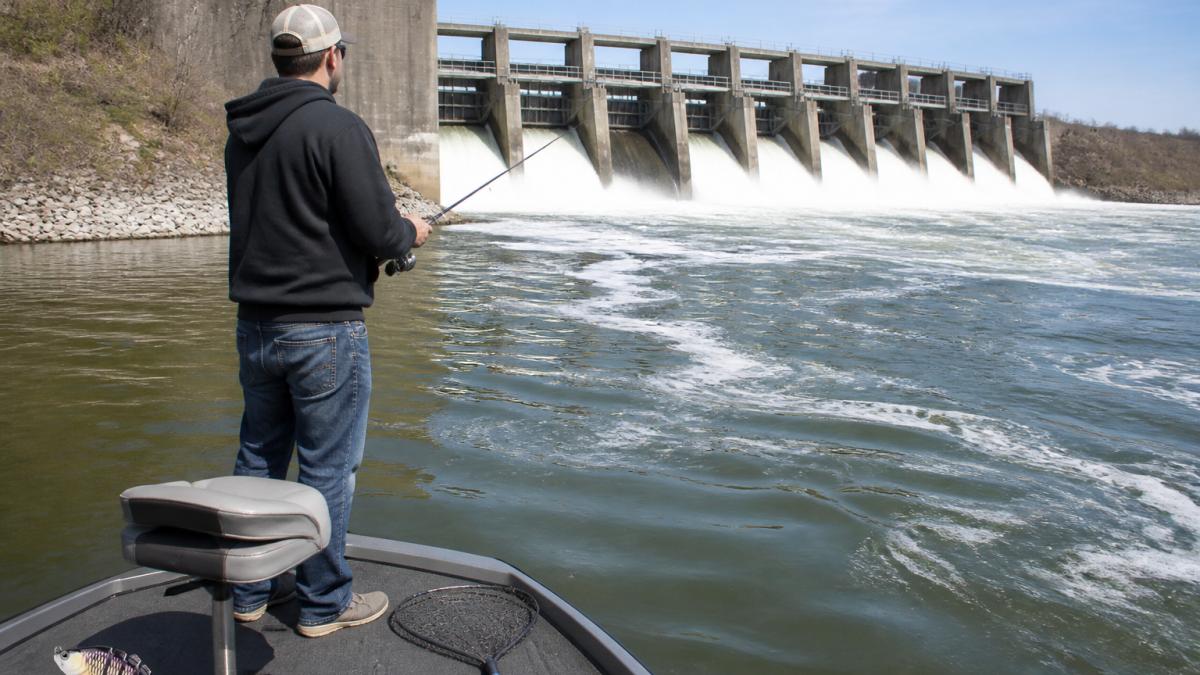
Best Lures for River Bass in Spring and Early Summer
Spring and early summer are peak smallmouth seasons on the Ohio River, but the river doesn't warm uniformly. Match lure type, size, and color to the spawn stage and water in front of you.
Early Spring: Pre-Spawn and Warming Water
When water climbs through the 50s, bass move from wintering holes toward staging areas. They're not on beds yet, but they're feeding, jerkbait and lipless crankbait time.
- Suspending jerkbaits (3-4 inches) in silver, black, and ghost patterns. Work them with two or three sharp jerks, then a pause of three to five seconds. In water below 55°F, lengthen the pause. Bass often take the lure while it sits still.
- Lipless crankbaits (1/4-1/2 ounce) in chrome and red craw patterns. Cast parallel to rocky banks and rip them over grass flats and shell beds. The vibration helps fish locate the bait in stained early-season water.
- Small swimbaits (3-4 inches) on 1/8-3/16-ounce heads. Slow-roll them along the first drop-off outside current. This mimics baitfish that are still sluggish in cold water.
A common pattern: start with a jerkbait until the water hits the mid-50s, then switch to a lipless crankbait. If the river runs high and muddy after spring rain, move to a spinnerbait or dark-colored tube.
Mid-Spring: Spawn and Shallow Cover
As water reaches the low 60s, smallmouth move shallow to spawn. They're less selective but spookier: finesse and natural colors in clear water, power-fishing in stained water.
- Tube baits (2.5-3.5 inches) on 1/8-1/4-ounce jig heads. Cast to bedding areas and rocky flats, let the tube fall, and hop it with short twitches. The tentacles create action with minimal forward movement.
- Ned rigs (2.75-3-inch stickbaits) on 1/16-1/8-ounce heads. Drag them slowly across gravel and shell. The stand-up profile keeps the bait visible to fish holding tight to cover.
- Texas-rigged craws (3-4 inches) with a 1/8-1/4-ounce bullet weight. Flip them into wood and rock crevices. Use a pegged weight to keep the bait compact when skipping under overhangs.
In clear water, use natural browns, greens, and pumpkin. In stained water, switch to black and blue or chartreuse. If the current is strong, increase jig-head weight by one size to stay in contact with bottom.
Late Spring to Early Summer: Post-Spawn and Current Breaks
Once spawning ends, bass move to current breaks, eddies, and deeper riffles to recover and feed, reaction baits shine.
- Spinnerbaits (3/8-1/2 ounce) with Colorado or Indiana blades. Cast upstream and retrieve just fast enough to feel the blade thump. In muddy water, use a single Colorado blade and a dark skirt with a chartreuse trailer.
- Squarebill crankbaits (1.5-2.5 inches) in shad and craw patterns. Bounce them off rocks and wood in 2-6 feet of water. The square bill deflects off cover and triggers reaction strikes.
- Swim jigs (3/8-1/2 ounce) with a 3.5-4-inch trailer. Cast into eddies behind bridge pilings and rock points, let the jig sink, and swim it back with a steady retrieve. This mimics a fleeing baitfish and covers water fast.
Early summer also brings topwater opportunities at dawn and dusk. Small poppers and walking baits (2.5-3.5 inches) in silver and black work over shallow rock flats and around weed edges. Fish them with a walk-the-dog cadence and pause after each strike.

Matching Lure to Water Level and Flow
River level and flow dictate lure weight and profile.
A simple rule: if you cannot see your lure 12 inches deep, switch to a lure with a rattle, a Colorado blade, or a dark silhouette.
Match lure type, size, and color to the season and water conditions throughout spring and early summer.
| Season | Lure Type | Size | Best Pattern |
|---|---|---|---|
| Early Spring (water 50s°F) | Suspending jerkbait | 3-4 inches | Silver, black, ghost |
| Early Spring (water 50s°F) | Lipless crankbait | 1/4-1/2 ounce | Chrome, red craw |
| Early Spring (water 50s°F) | Small swimbait | 3-4 inches | On 1/8-3/16-ounce heads |
| Mid-Spring (water low 60s°F) | Tube bait | 2.5-3.5 inches | On 1/8-1/4-ounce jig heads |
| Mid-Spring (water low 60s°F) | Ned rig | 2.75-3 inches | On 1/16-1/8-ounce heads |
| Late Spring to Early Summer | Spinnerbait | 3/8-1/2 ounce | Colorado or Indiana blade |
| Late Spring to Early Summer | Squarebill crankbait | 1.5-2.5 inches | Shad, craw patterns |
| Early Summer (dawn/dusk) | Topwater popper | 2.5-3.5 inches | Silver, black |
River Fishing Lures for Current: Rigs and Retrieves
Current demands specific rigging. Two rigs dominate Ohio River fishing.
Carolina Rig Setup and Presentation
The Carolina rig is a river workhorse: a sinker, bead, swivel, leader, and soft plastic. The sinker bounces along bottom while the lure trails behind.
Set it up like this:
- Slide a 1/2-ounce to 1-ounce sinker on your main line
- Tie a bead above the sinker to protect your knot
- Tie a barrel swivel to your main line
Cast upstream and let the current work the rig. The sinker taps bottom, creating vibration, while the lure dances behind it, triggering bass, catfish, and walleye.
A 1/2-ounce sinker works for most Ohio River conditions; go heavier near dams and lighter in slow pools.
Jigs and Football-Head Rigs
Football-head jigs excel in current. The flat bottom keeps them stable on rocky substrate, so they don't roll like round-head jigs.
A 1/2-ounce football jig paired with a soft plastic creates a compact, snag-resistant presentation.
Pair the football jig with a 2-3 inch tube or craw imitation. Cast it into current breaks and work it slowly, letting each bottom bump send vibration that attracts fish.
Lures for Muddy Water Fishing: Color and Visibility
Muddy water appears after heavy rain or increased dam releases.
For muddy water, forget natural colors. Use bright, high-contrast lures.
Vibration matters more than appearance.
Size up slightly in muddy water: larger lures create more vibration and are easier to locate.
Best lures for muddy water fishing guidance confirms that muddy conditions demand high-contrast colors and vibration-producing lures to cut through reduced visibility.
You can also explore best baits alternatives for rivers when lures aren't producing in heavily stained water.
Spinnerbaits and Inline Spinners for Multispecies Fishing
Spinnerbaits and inline spinners are among the most versatile Ohio River lures, triggering smallmouth, largemouth, walleye, sauger, white bass, hybrid stripers, and even catfish. Match blade type, weight, and retrieve speed to the species.
Blade Types and What They Do
- Colorado blades produce maximum vibration and slow rotation. They're best in muddy water, at night, and in cold water when fish are less active, when fish need to feel the lure before they see it.
- Willow leaf blades rotate fast and produce flash with less vibration. They cut through current efficiently and are ideal for clear water and active fish chasing baitfish.
- Indiana blades fall between Colorado and willow, balancing flash and thump for stained water or when you're unsure which extreme to choose.
Species-Specific Selection and Presentation
Largemouth bass: Use a 1/2-ounce spinnerbait with tandem willow leaf blades around wood, weed edges, and backwater sloughs.
Walleye and sauger: Use a 1/4-3/8-ounce spinnerbait or a 1/8-1/4-ounce inline spinner tipped with a nightcrawler or minnow.
White bass and hybrid stripers: Use a 1/4-1/2-ounce inline spinner or a small spinnerbait with willow blades.
Catfish: Use a 1/2-ounce spinnerbait with a Colorado blade and a bulky trailer.
Rigging and Retrieve in Current
The biggest spinnerbait mistake in rivers is retrieving too fast. In current, the water already adds action. Slow down until you feel the blade thump, too fast and the bait rolls without turning the blade.
- Cast upstream at a 45-degree angle and let the lure sink to the desired depth before starting the retrieve. This keeps the lure in the strike zone longer.
- Use a trailer (split-tail grub or swimbait) to add bulk and slow the fall. In muddy water, a chartreuse or white trailer adds visibility.
- Vary retrieve speed until you find what the fish want. Start slow, then speed up in increments. Most strikes come on a change of speed, so give the reel a quick turn or two, then slow down again.
Color Selection by Water Clarity
- Clear water: natural shad, silver, bluegill, and black. Use willow blades for flash.
- Stained water: chartreuse, white, and fire tiger. Use a mix of Colorado and willow blades.
- Muddy water: black, dark blue, and chartreuse with a single Colorado blade. Add a rattle if the lure does not have one.
A practical rule: match the blade to water clarity and the skirt to forage. In clear water, a silver willow-leaf spinnerbait with a shad-colored skirt mimics a baitfish.
Ohio Department of Natural Resources fishing guidance notes that matching lure color and action to water conditions is a consistent factor in river fishing success, and spinnerbaits are a practical way to cover both vibration and flash in changing water.
Building Your Ohio River Lure Selection
You don't need a tackle box full of lures.
To choose lures Ohio River anglers rely on, start with these core options:
- Soft plastic tubes (2-3 inches) in natural and chartreuse
- Small jerkbaits (2-3 inches) in silver and black
- Football-head jigs (1/4 to 1/2-ounce) in black and brown
This foundation covers 80% of Ohio River situations.
Rotate your selections with the season. Spring demands reaction lures like jerkbaits.
Quality matters more than quantity. The Creme Wiggle Worm 6" 4-pack at $4.99 gives you proven soft plastics.
These lures work because they're built to trigger strikes, life-like action, proper weight distribution, and proven colors.
Frequently Asked Questions
What lures work best for smallmouth bass in rivers?
Smallmouth bass in rivers respond well to soft plastics like tubes and crawfish imitations, hard jerkbaits, and spinnerbaits. In spring, dark-colored baits trigger more strikes. Choose lure size based on water clarity: smaller profiles in clear water, larger lures in stained conditions. A 1/2-ounce football jig paired with a Carolina rig has proven effective on the Ohio River.
How do you choose a fishing lure for current?
In strong current, use heavier jigs and football-head rigs that maintain bottom contact and stay in the strike zone. Vertical presentations work better than horizontal casts. Spinnerbaits with Colorado blades create vibration that attracts fish in moving water. Match your retrieve speed to the current strength, faster retrieves in slower sections, controlled drops in fast water.
What lures work best in muddy river water?
High-contrast colors cut through muddy water. Chartreuse, white, and black lures are most visible. Use compact jigs and soft plastics that displace water and create vibration. Colorado-blade spinnerbaits generate extra vibration to help fish locate your lure. Avoid natural colors in stained water; switch to brighter patterns that stand out.
Should you use different lures in clear and stained water?
Yes. In clear water, use natural colors and smaller profiles to avoid spooking fish. In stained or muddy water, switch to high-contrast colors like chartreuse and black. The Ohio Department of Natural Resources recommends dark-colored baits in spring and lighter colors in fall, accounting for seasonal water clarity changes. Adjust both color and lure size to match conditions.
Choosing lures for the Ohio River works when you match conditions to presentation. Water clarity drives color choice. Current dictates weight and rig selection. Season determines lure type. The 573 Lures selection process removes the guesswork. We hand-pick lures that perform on rivers like the Ohio because our team fishes these waters. That experience translates to your success. Start with the core lures, match them to conditions, and fish with confidence.
